How can high-quality accelerated learning experiences be designed to meet the needs of every student?
Diagnostic and formative assessments are a powerful tool for indicating where students are along the learning progression toward grade-level instructional goals (visit the Data-Driven Instruction section of the PAL for more information). The act of measuring alone, however, isn’t enough to make improvements. As the last section of this PAL detailed, it is what we do with that data that matters. The data can help educators tailor their approach to supporting each student – deciding what each student needs to move forward, which interventions to offer, considering how they are organized, and the conditions under which each student will learn best. However, educators need more than assessment data to develop learning that meets students where they are and helps them to grow as quickly as possible.
In this chapter, we will explore the components of personalized learning and how designing learning experiences that center students creates the conditions for learning acceleration.
Defining Personalized Learning
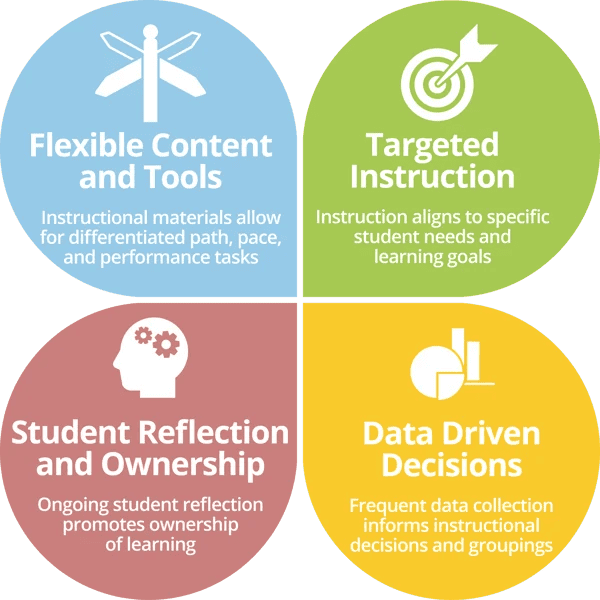
Personalized learning occurs when teachers tailor their approach to meet each learner where they are today, thereby maximizing their progress. As this image from Education Elements illustrates, this model requires educators to:
- Gather regular data on learners as whole people
- Use that information to tailor instruction to meet students where they are
- Differentiate their scaffolds, assignments, pacing, and assessments
- And partner with students as owners of their own learning journey.
The ultimate goal is to help each learner grow from where they are to where they need to be in a way that works best for them. It’s a flexible, authentic, student-centric, data-driven instructional model that has been proven to promote student agency and growth.
To really individualize learning, educators need to know students well. Brain science research indicates that learning is most effective when it is connected to what we already know. So, when we connect current learning to what they already know and understand, we get even better results. This personalized, brain-science-backed approach has been shown to close learning gaps more quickly and support students in staying on track once they catch up. It also promotes equity by tailoring educational experiences to individual students’ needs, which can help to dismantle systemic barriers that may have historically prevented certain students from accessing the kinds of learning opportunities they need to succeed.
In essence, personalized learning is about teaching smarter by focusing on the individual learner and providing them with the right support at the right time to accelerate their learning. Approaching learning this way means educators need to know a great deal about students – the way they think, what they already know, what they are interested in, and what kinds of learning experiences they respond to best. This knowledge enables them to design targeted support, select appropriate interventions, and tailor resources that help each student grow in areas where they need improvement, building on their strengths. Research shows that when educators plan and teach in this way, students are more engaged and motivated, gain a deeper understanding of the content and skills, and learn more effectively.
Isn’t That Differentiated Instruction?
To some degree, yes. Differentiated instruction and personalized learning both aim to address diverse student needs, but they differ in the degree of customization and the level of student engagement. Differentiated instruction asks educators to adjust existing curriculum and instruction to meet the assessed interests, readiness, and preferences of students within a classroom. Generally, this means using regularly collected formative data to predict the likely needs of learners and create a set of options for future learning. These options might include the adjustment of the content (the knowledge, understanding, and skills students need to learn), process (how students are learning about the content), product (the ways students show what they know, understand, and can do), or learning environment (the pace, time, and space within which students work) to maximize the potential of a group of learners to meet a common instructional goal. For more on differentiation, check out Key Elements of Differentiated Instruction.
Personalized learning takes it a step further by asking educators to start with what they know about a student’s interests, passions, and experiences, and then customize instruction based on the assessed strengths, needs, and experiences of individual students, further tailoring their approach to best fit each student. It also asks educators to rethink how they engage and empower students by involving them as active participants in the design of their learning, such as through reflection, self-assessment, goal-setting, and choice. For more information on personalized learning, visit the Aurora Institute’s guide to Getting Started with Personalized Learning, which provides resources for education leaders, teachers, and policymakers seeking to redesign K-12 education around student learning through personalized learning and competency education.
For a quick overview of the distinctions between differentiated instruction and personalized learning, check out:
- This post by Aequitas Solutions, Differentiated vs. Personalized Learning: Finding the Right Approach for your Students
- This chart created by TeachThought
Rethinking the Conditions for Learner Success
Learning acceleration through a personalized learning approach is possible when we focus on conditions that help students see themselves as capable learners. This means educators and systems need to think carefully about both the instructional approach and the environment and conditions in which students learn. This means more than attending to the physical setup of the classroom–its layout, lighting, or materials. It is also about considering how students feel in that space—physically, socially, psychologically, and cognitively. Research indicates that learning conditions—particularly social and psychological factors—can have a profound impact on student outcomes, encompassing academic performance, social and emotional well-being, and readiness for college, careers, and life beyond the classroom. When students perceive their classroom environment as positive–when they feel safe, seen, and heard– they are more likely to achieve higher grades, particularly in subjects like math, where the quality of learning conditions strongly influences academic success. This finding holds true across student socioeconomic and racial groups and is a factor in closing long-standing achievement gaps. Visit CCEE’s Field Guide for Learning, Equity, and Well-Being to find more information on creating a learning culture, or the Build Sustainable Learning Acceleration Systems section of this playbook for more details.
A recent study on the conditions for learning math highlights that when educators create a supportive and encouraging classroom environment, students are more likely to experience substantial learning gains than in a classroom where the environment is less intentional. The article lays out four positive classroom learning conditions that allow students to thrive in mathematics classrooms:
Supportive Relationships:
Sense of Belonging:
Growth Mindset:
High-Quality Instruction:
Similar recommendations exist for creating the conditions for learning in language and literacy classrooms. When students learn in spaces where they feel safe and empowered, and where their voices and identities are valued, they are more likely to take ownership of their learning, leading to greater academic engagement and success.
Isn’t That Universal Design for Learning?
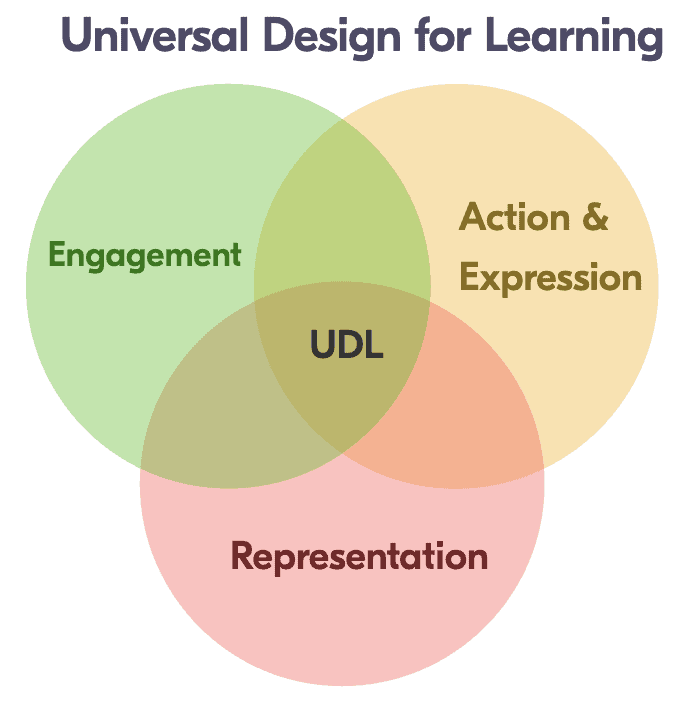
Universal Design for Learning (UDL) is a great place to start when considering learning environments that set students up for personalized learning success, as this approach builds support into the learning architecture from the outset. Even before knowing students individually, the research behind the UDL model suggests that it is possible to anticipate what a variety of students might need to successfully access and engage in learning based on decades of scientific insights into how humans learn. Just as an architect might incorporate ramps, sidewalk cutouts, and elevators into a building, educators can also proactively reduce physical, psychological, and other barriers in their classrooms, designing flexible learning environments and instruction that are inclusive of a range of learners. The UDL guidelines focus on building structures that offer multiple means of engagement, representation, action, and expression, allowing students to choose how to engage and thereby empowering them to become active, strategic, and purposeful learners. Its primary goal is to cultivate learner agency, which is critical for learning acceleration success. Thus, UDL is a great Tier 1 intervention that can and should be implemented in every classroom.
UDL, however, is not enough. As its name implies, the support offered by this framework is universal. As previously described, personalized learning occurs when “educators cater to the strengths, interests, and needs of students through instructional strategies, personalized goals, and action-oriented assessments in flexible learning environments” (Bingham et al., 2017). As educators learn more about their students, they will need to extend beyond UDL to continue tailoring their learning environment, along with their instructional approach, to meet the individual needs of students in their classroom. A teacher might, for example, ask students to self-assess their own beliefs about themselves as readers and then use that data to consider how to adapt their own language and instructional approach to support their students’ confidence while they read. Building on a proactive UDL strategy of offering students choices of what they read, the teacher might offer a range of modalities for students to access the text, such as providing an audio version of the text alongside the text itself, and thinking carefully about how they introduce these choice supports for students to avoid inadvertently stigmatizing options, thus avoiding any further erosion of students’ self-efficacy as readers.
Personalizing Learning in the Classroom
Creating customized learning for students may seem like an overwhelming task for classroom teachers. However, there are numerous ways educators can increase personalization or student-centered instruction, even in a classroom of 30 students. Below is a list of sustainable, MTSS Tier 1-aligned approaches that build on practices many teachers already employ. These ideas can also serve as the basis for redesigning schools to promote student success, as outlined in the Learning Policy Institute article.
Start with UDL
Universal Design for Learning encourages educators to consider students who will require the most access and to design their learning environment with these students in mind, even before they enter the classroom. Consider doing an audit of your current classroom environment, instructional practices, materials, and resources using the UDL Guidelines as a rubric or these UDL observation tools. Where might you enhance accessibility or provide more flexible support? Beginning with these research-based structures will ensure that the conditions for learning acceleration are built into the classroom’s architecture from the outset. For more on successfully implementing UDL in California classrooms, visit the UDL Journey Guide created by CCEE and CAST.
Focus on relationships and social connections
In socially connected learning environments, students are encouraged and able to make meaningful, supportive connections with teachers, experts, peers, and the content of their learning, which contributes to their ability to persist, deepen their commitment, and co-create together. Environments and practices that support students’ social, emotional, and academic development create spaces for students to thrive–a key component of educational equity. Start by getting to know students as whole people – their strengths, concerns, experiences, interests, and self-perceptions, as well as their instructional knowledge levels- and build individual student profiles, such as this one from the New Teacher Center. Reflect on how you can use this information to adapt your learning environment and instruction to better align with your students’ strengths, needs, identities, and experiences.
Intentionally build trust and positive professional rapport with students. Students work for teachers they trust, feel have their best interests in mind, value them as whole people, and who are supportive. Even small moves, such as greeting students at the door, learning their names and using them consistently, asking students to share their experiences and perspectives, and thoughtfully sharing your own, stating and maintaining expectations, modeling appropriate interactions, and following through on consequences calmly and respectfully, make a huge difference. Visit the CCEE Field Guide on Accelerating Learning, Equity, and Well-being, and this article from the Institute of Education Sciences, for more strategies to intentionally build student-teacher relationships.
Students also need to know and trust one another. Do students know each other’s names? Do they see each other as resources? Do they know how to talk with one another or resolve differences? Creating intentional opportunities for students to get to know one another, such as through open discussions, thoughtfully constructed cooperative learning activities, and reciprocal teaching, can significantly contribute to developing a community where every student feels safe, seen, and respected. This article from the National Center on Safe Supportive Learning Environments offers more ideas for promoting positive peer-to-peer relationships in classrooms. The Learning Accelerator also outlines various options for organizing collaborative student work.
Build student agency
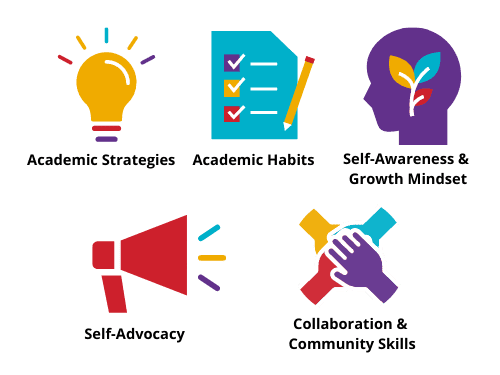
When students are empowered and self-directed learners, they are more likely to remain engaged, persevere through challenges, and achieve academic success — a necessary mindset for learning acceleration. Students develop this agency by having a clear understanding of where they are and where they are going, with multiple opportunities and ways to get feedback, demonstrate competency, and plan next steps. This means creating regular and authentic opportunities for students to:
For more information on developing student agency, visit the UCLA Center for Community Schooling or explore this menu of student opportunity practices from AIR.
Use data to adapt the environment and instruction
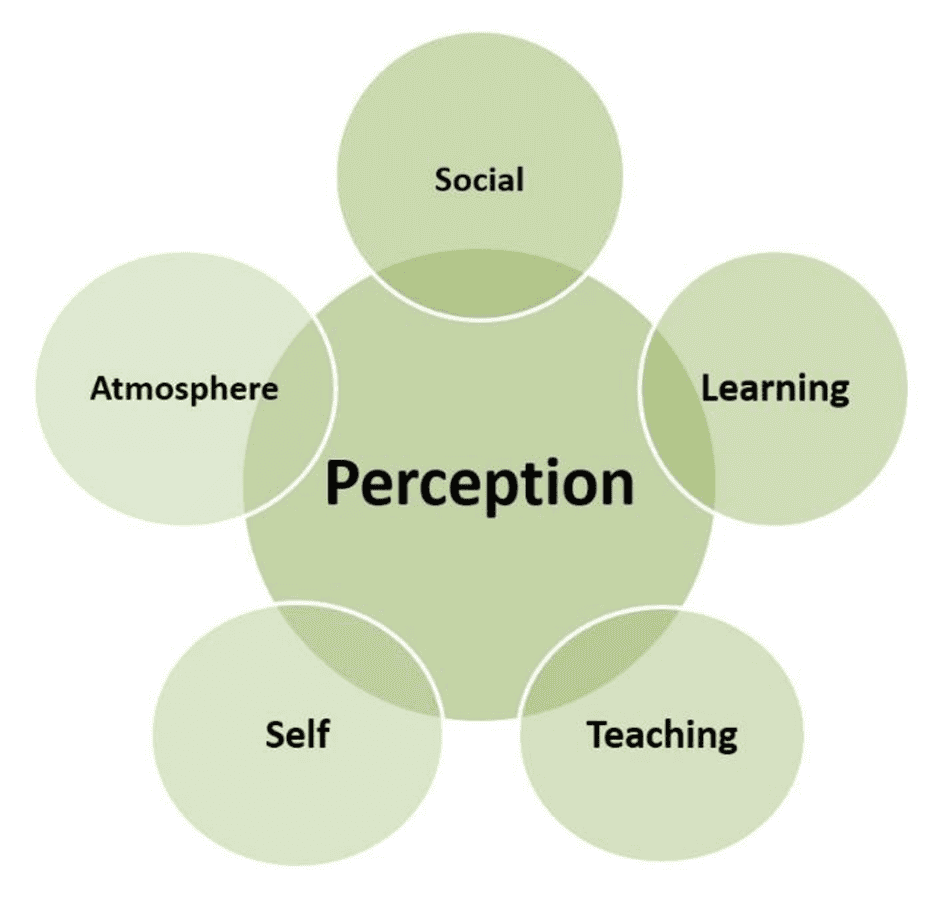
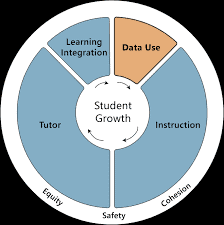
Individualized learning starts with the assumption that the more we know about students, the better we can tailor our work to support their learning acceleration. So, gathering, interpreting, and using a range of data sources to continuously refine both the learning environment and instruction must be at the heart of our approach. Short-cycle formative assessment data aligned to instructional outcomes are most helpful in tailoring learning. Educators may also consider utilizing performance-based assessments, such as project-based learning and portfolios, as they can offer students a different, and perhaps more authentic, way to demonstrate their understanding and help teachers better understand where students are in their learning more clearly. As the image illustrates, educators will also want to regularly gather student perception data that helps teachers know more about how students feel about themselves, their learning progress, the classroom community, and the instruction they are receiving. This data can support quick changes in approach, inform students’ goals, and help educators identify and address any barriers to learning that may persist. New Visions for Public Schools has created a toolkit of student perception surveys, which may serve as a helpful starting point.
Plan meaningful instruction.

The most important part of high-quality, individualized learning is the instruction facilitated by the teacher in the classroom. It must be standards-based, meaningful work that intentionally builds towards mastery. Such instruction regularly asks students to activate their current knowledge as a connector point for new learning. It engages students in authentic inquiry, helping them develop meaning through approaches such as problem-based learning, project-based learning, hands-on activities, inquiry-based lessons, and virtual simulations. It scaffolds and then de-scaffolds learning as students show increased readiness and skill. It centers engaged collaboration with peers, prioritizing active learning over teacher talk time. Meaningful instruction in the context of rich learning experiences helps students see themselves as capable learners, engaged in worthy work, who can persevere through rigorous tasks with the support of their teacher and peers. Equitable Math notes that creating rigorous, grade-appropriate, and meaningful instruction that fosters deep content understanding is crucial for both learning acceleration and increased educational equity. Watch this video to see an example of meaningful instruction that builds student agency and engagement in action:
Build in flexible learning.

At the center of personalized learning is an educator who knows how to design a range of differentiated pathways for students to engage with new content and skills. Building on student profiles and formative data, educators can create a range of flexible learning configurations that help each student access just-in-time support to accelerate their learning. In addition to creating scaffolds that might support learners during traditional instruction, educators might consider the following:
- Creating customized playlists for students. A playlist is a sequence of resources and/or activities for students. Playlists enable students to practice just-right learning concepts at their own pace, allowing teachers to track their progress and offer support when needed. For example, Cisco Independent School District uses an individualized assignment chart that students work through at their own pace. Valor Collegiate in Tennessee personalizes math practice through self-directed and self-paced online playlists housed in Google Docs. Each playlist is focused on a grade-level math standard, allowing students to self-select a targeted playlist based on their individual needs. Playlists and other individualized learning pathways support student agency and self-direction, enabling students to progress at a pace that suits them best.
- Organizing non-permanent small groups that allow educators to pull students together to address a common need by providing short, highly-tailored instruction to best meet students where they are, build background knowledge, address a common misconception, or accelerate the learning of those ready to move forward more quickly. One example might be to create study groups as described in research by Jo Boaler. Study groups, consisting of 3-4 students, help expose students to different perspectives on any given subject and observe various approaches to a problem. They can be flexibly organized in the classroom around an assigned classroom task. Consider how you can use paraeducators, volunteers, student teachers, and other staff to create simultaneous small groups.
- Using a rotational model that incorporates both small-group instruction led by the teacher and other forms of learning, such as individual or station-based learning. Station rotations involve students working in small groups that rotate through a series of learning experiences guided by the teacher, collaborating with peers, and/or working independently. For example, in Mississippi, the K-3 reading program’s learning progression is designed as a rotational model, incorporating whole-group, small-group, and individual work. While traditionally an elementary school model, stations are equally powerful practice for middle and high school students. Block scheduling at the secondary level provides an ideal amount of time for this model. When the stations and groupings are carefully configured to ensure that each student’s experience in each rotation aligns with their personal learning needs, rotational learning can be a meaningful and individualized approach to learning.
- Trying flipped instruction. In a flipped classroom, students watch a video lesson to learn the material at home, then come to school and have class time to work on problems where the teacher and fellow students are available to answer questions. Moving content online allows students to review challenging materials multiple times, watch lessons with captions to support language acquisition, or advance more quickly when they are ready. This allows for personalized pacing of instruction, freeing up time in class to practice, apply, collaborate, and explore the material in greater depth.
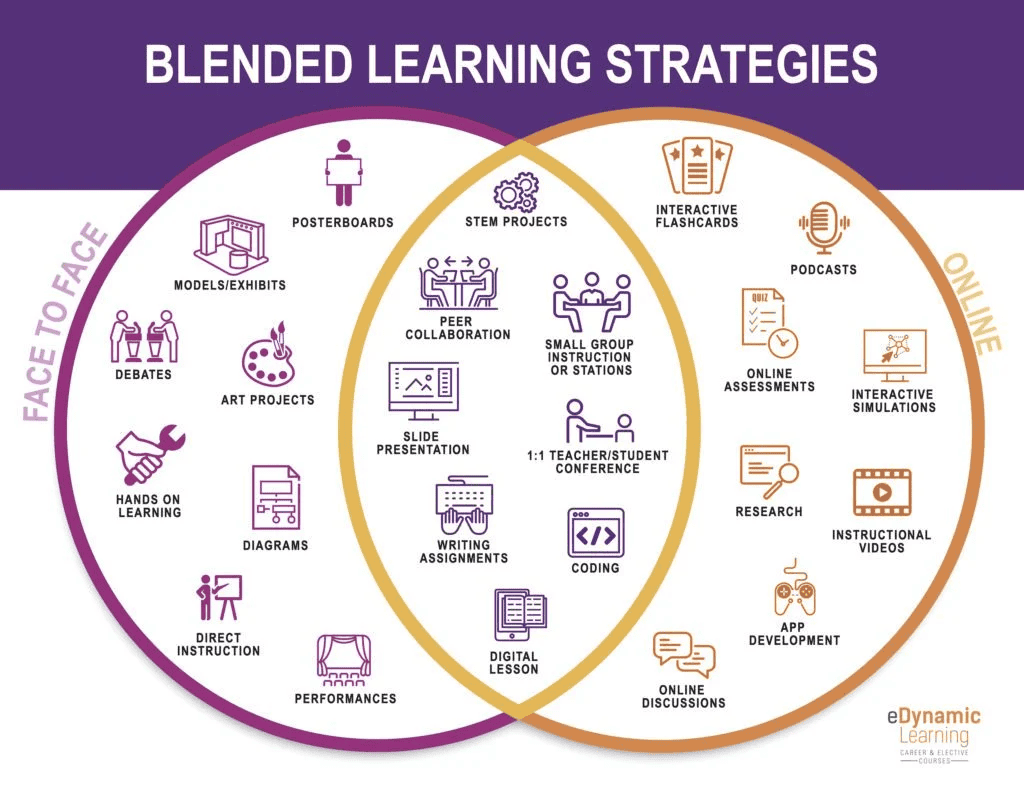
- Offering blended learning. Blended learning combines online learning opportunities with traditional place-based classroom methods. In some iterations, students learn content online at their own pace and then work with others to practice using that new knowledge (see the image for more ideas).
Notice and respond when individual students need more. When individual students are still not able to meet learning targets, even with classroom-based personalized learning efforts, educators must move quickly to adjust their approach and prevent students from falling behind. Similarly, if students consistently exceed expectations and their pace of learning cannot be effectively supported by classroom efforts, adjustments must also be made to avoid inadvertently holding back students showing advanced proficiency. Offering immediate, on-demand, and targeted instructional interventions, as well as Tier 2 and 3 supports, is needed. Often, these interventions extend beyond the classroom, requiring whole team, school, or district structures. For example, Da Vinci Connect High School uses office hours and study groups to accelerate learning. Office hours are designed to facilitate small-group or one-on-one interactions between students and a teacher, with a small student-to-teacher ratio, either during class or at other times of the day. This allows students to participate more freely and openly with the teacher. It is also an opportunity for students and teachers to get to know each other. Other schools may turn to high-impact tutoring or other methodologies that reduce the student-to-teacher ratio, allowing for increased personalization (see below for more information about high-impact tutoring).
The Power of High-Impact Tutoring for Personalized Learning
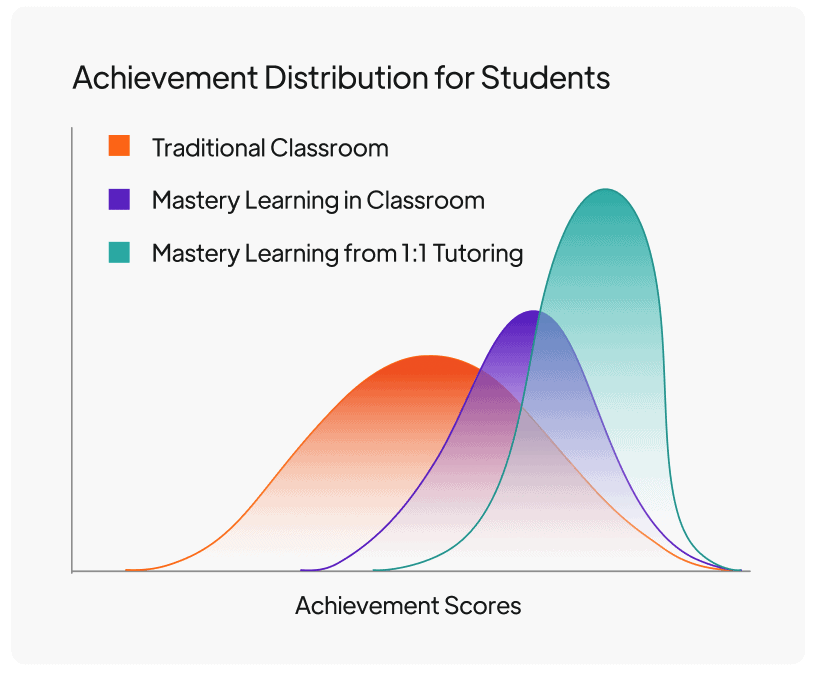
High-impact tutoring is unusually effective at accelerating learning because it is the ultimate personalized learning experience. In this model, students work one-on-one with an educator or in a very small group, in an intensive and targeted manner over a period of time. By responding to students’ individual needs, complementing the existing curriculum, and supplementing (not replacing) students’ quality Tier I classroom instruction as described above, high-impact tutoring leads to substantial learning gains for students and an increase in students’ self-confidence. As Benjamin Bloom found in his Two Sigma Problem, “Most students have the potential to reach a high level of learning” when engaging in 1:1 learning. As the image shows, nearly 98% of students perform higher than baseline classroom performance, compared to 84-90% with master learning, because, when the educator is well trained and works consistently with the student, they can perfectly tailor their approach to the individual student and create an ideal learning environment for that learner. A review of 96 randomized control trials further finds that tutoring yields significant improvements– sometimes as much as twice the norm, making it the most effective intervention to have been tested. Those results hold across all grades and content levels, demonstrating a strong track record of closing achievement gaps between racial groups. For example, this Chicago study found that the Black-White math test score gap narrowed by almost a third in one year.
Not all tutoring initiatives have the same results, however. High-impact tutoring is most effective when it includes these design principles, with essential elements summarized below:
- Consistent, effective, and relational tutors. Tutors need to be highly knowledgeable, trained, and supported to effectively deliver targeted instruction and build positive, trusting relationships with students. They should also be closely supervised to ensure they provide the high-quality support that students deserve. Programs should provide quality initial training on content and facilitation skills, as well as ongoing support for tutors. Consistency is also key. Students need to meet with the same tutor throughout the program to foster trust and a strong relationship. Certified classroom teachers, paraprofessionals, teacher candidates, college students, or trained volunteers from organizations such as AmeriCorps can be great groups from which to recruit tutors.
- High-quality curriculum and instructional materials. High-impact tutoring complements the classroom curriculum and learning objectives. Therefore, it needs to be grounded in research and aligned with the standards taught in the class. Like content teachers, tutors should also have access to high-quality instructional materials that are aligned with state and local standards and curricula.
- Frequent and consistent intensity. Research indicates that tutoring sessions should occur three times per week, each lasting 30-60 minutes, for a total of 90 minutes per week to be most effective. Tutoring interventions conducted during the school day consistently yield greater student attendance and academic outcomes than those held after school or during the summer. However, if tutoring must be scheduled outside of school time, it is crucial for programs to promote and prioritize attendance and meaningful engagement. With the passage of major funding initiatives, such as the Expanded Learning Opportunities Program (ELO-P), California has made an unprecedented investment in supporting students beyond the traditional school day. This recorded webinar features California districts implementing high-impact tutoring programs during the school day and extended-day programming, leveraging ELO-P funds.
- An appropriate teacher-to-student ratio. Tutors should ideally work with small groups of not more than 1:3 to ensure personalized attention and to build strong relationships with students.
- Data-Driven and Targeted. Tutors need access to students’ regular assessments so they can use that data to inform session content, adjust their approaches, and ensure continuously targeted interventions, rather than offering a generic or canned program. Establishing a feedback loop with teachers and tutors ensures tutoring support is tailored to the student and aligned to classroom instruction.
High-impact tutoring is more than just occasional help with homework. As this image from the National Student Support Accelerator illustrates, high-impact tutoring is a structured, evidence-based approach designed to provide students with the additional, intensive, and targeted layer of support they need to thrive academically as an MTSS Tier 2 or 3 intervention. Wondering if your LEA’s current tutoring efforts or programming align with evidence-based quality standards? Check out the National Student Support Accelerator’s Tutoring Quality Improvement System (TQIS) and LEA self-assessment tool.
For more on implementing a high-impact tutoring program, here are a few strong resources:
- The National Student Support Accelerator’s High-Impact Tutoring District Playbook includes a workbook to guide districts through the development process, a toolkit for tutoring programs, a resource on aligning tutoring curricula with school curricula, and a searchable database of tutoring program providers.
- JPAL’s guide to designing an evidence-based tutoring system offers a thorough examination of the components of an effective program, offering recommendations and guidance for districts.
- CCEE, in collaboration with JPAL, developed this learning path for implementing evidence-based tutoring programs for high impact.
- FutureEd at Georgetown’s Tutoring Playbook includes helpful funding considerations and extensive tips and tools.
- This video primer, created by CCEE and the National Student Support Accelerator, provides a comprehensive overview of the model, best approaches, and how to get started, presented by tutoring expert Dr. Susanna Loeb.
- Peruse the BRIDGES to Learning Acceleration Framework created through a collaboration between the California Collaborative for Learning Acceleration (CCLA) and the Department of Educational Leadership at San Diego State’s College of Education.
- Watch the Tulare County Office of Education talk about their Learning Acceleration work in this video.
For more on implementing a high-impact tutoring program, here are a few strong resources:
Educators Need Strategic Supports And Professional Learning
Personalized learning, as described in this chapter, to promote learning acceleration, is not something individual educators can be expected to design and implement on their own. This model asks teachers to build positive learning environments, be well-versed in a range of approaches to learning, be knowledgeable about how to adjust their plans to meet student needs in real-time while also staying on track to meet grade-level learning targets, and know how to partner with tutors and others to offer aligned supports for students. Educators will need support in learning about and successfully implementing a range of new ideas related to personalized learning, as described in this section. This includes understanding what personalized learning is and how it is connected to learning acceleration. This section of the PAL can help guide some of that learning. They will also need support in harnessing the potential of instructional technology that the school or district is using to support personalized learning. ISTE ‘s Standards for Educators, the National Standards for Quality Online Teaching, and this resource on Providing Effective and Equitable Digital Learning for All Students may be helpful in guiding planning. There are additional resources in the mathematics and ELA/ELD frameworks on technology use.
It starts with leadership. Learning acceleration will only be truly successful when schools and systems allocate the necessary time in their schedules to make it happen. Classroom teachers can only control what happens in their classrooms, so school and system leaders need to set district-wide goals, create a shared understanding of what personalized learning means in their context, and create the foundation of systems, structures, communication, technologies, and collaboration required for personalized learning. These include finding and allocating resources, being creative with staffing, providing training and coaching, and making time for collaboration. For more information on how leaders can establish systems for learning acceleration success, visit the “Build Sustainable Learning Acceleration Systems” section of the PAL.