
Learning Acceleration is about keeping students motivated by providing grade-appropriate work and offering just-in-time interventions (the right type of or amount of support at the right time) to fill gaps in learning.
Acceleration vs. Remediation
The terms “acceleration” and “remediation” are sometimes used interchangeably but represent two vastly different approaches to learning. To avoid confusion, let’s begin by clearly differentiating between them. In this video, Dr. Darling-Hammond defines acceleration and explains some key research backing this approach.
Remediation purports to support students who have fallen behind by focusing primarily on helping students master concepts they should have learned in previous years. This often means revisiting prior grade-level content and working to fill in any gaps in understanding. When students spend their time in remediation, however, they may not have the opportunity to practice with content appropriate for their current grade level. This approach can put students further behind, has diminishing returns, and exacerbates inequity. Further, we know that remediation is often composed of “drill and kill” approaches, which breed stress, anxiety, disengaged and reluctant students, frustrated families, and even drive up rates of chronic absenteeism. Yet, students of color and those from low-income families continue to experience remediation more than wealthier white peers, even after demonstrating success on grade-level content.
Acceleration, on the other hand, makes it genuinely possible to get and stay caught up by leveraging what we know about how people learn effectively. While the term ‘acceleration’ might lead one to think that the goal is to simply speed through the curriculum, that’s not the intention. Instead, it’s about keeping students motivated by providing grade-appropriate work and offering just-in-time interventions (the right type of or amount of support at the right time) to fill gaps in learning. Instead of focusing on a list of items that students have not yet mastered (remediation), learning acceleration is a system-wide approach that strategically addresses unfinished learning using a whole-child approach.
For an example of what learning acceleration and remediation look like in action, check out this video from the Tulare County Office of Education showing a bridge building activity facilitated as both acceleration and remediation and what happens as a result.
Learning Acceleration Advances Educational Equity
Unlike remediation, several studies have found that learning acceleration is particularly effective for students of color and those from low-income families. When systems and educators adopt a learning acceleration approach that provides all students with access to grade-level material, it is effective, and students of color and those from low-income families benefit the most. While these students have historically been most likely to experience remediation, they also see substantial benefits from acceleration compared to remediation. According to the same report,
Classes that experienced learning acceleration in schools with mostly students of color saw a much smaller increase in their struggle rate compared to remediated classrooms (only one-tenth as large) and completed 49% more grade-level lessons. In Title I schools, classrooms with learning acceleration saw an increase in their struggle rate only one-sixth as large as in remediated classrooms and completed 28% more grade-level lessons.
But it wasn’t just that the classes that experienced learning acceleration struggled less. They also completed 27% more grade-level lessons. In fact, students in those classes mostly regained their pre-pandemic success on grade-level mathematics despite all the interruptions of the past year (see image below).
This data only further confirms the need for California’s schools to refocus their efforts on learning acceleration for all students.
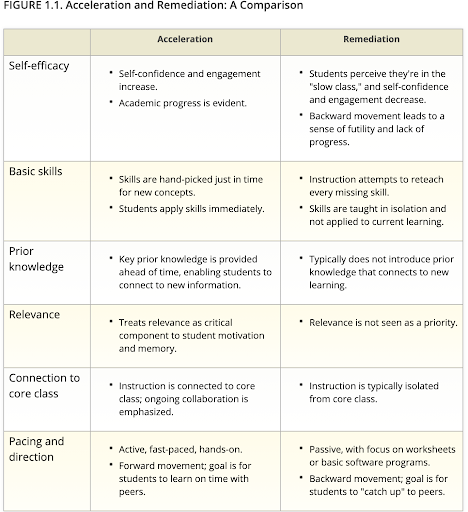
In summary, as this chart created by Suzy Pepper Rollins illustrates, remediation is about focusing on the past—what students missed last year and what they need to redo. On the other hand, acceleration focuses on starting students where they are and accelerating them forward using data and a deep understanding of the content to create an individualized and highly targeted pathway for each student.

At its core, a learning acceleration approach is about building bridges rather than filling holes.
- This brief animation video, developed as students returned to school after the pandemic, effectively illustrates the difference between remediation and acceleration.
- The California Collaborative for Learning Acceleration developed this self-paced, online course covering foundational elements of acceleration.
- The Appendix of this report provides an example of a remediation approach versus a learning acceleration approach that addresses priority content.
- Watch this video to hear more about how teachers and experts think about the difference between acceleration and remediation and why it’s so important.
Learning Acceleration Key Components
1. Strategically teach content.
2. Harness the power of data-driven instruction.
3. Create the conditions for personalized learning.
4. Embed strategic supports for diverse learners.
5. Design sustainable systems.
Want more about the difference between remediation and acceleration? Check out these resources.
- Peruse the BRIDGES to Learning Acceleration Framework created through a collaboration between the California Collaborative for Learning Acceleration (CCLA) and the Department of Educational Leadership at San Diego State’s College of Education.
- Watch the Tulare County Office of Education talk about their Learning Acceleration work in this video.
Learning Acceleration and MTSS

Since 2015, California has invested in the Scaling Up Multi-Tiered System of Support Statewide (SUMS) Initiative to provide LEAs with the necessary resources to implement the MTSS framework effectively. Learning Acceleration complements the MTSS framework. Both approaches provide a strong, research-based foundation that encourages the use of data-driven decision-making to create supports tailored to the strengths and needs of individual students. They also center on developing flexible and targeted interventions to ensure that all students, regardless of their starting point, meet or exceed grade-level expectations. Both models encourage a focus on the whole child, including not only academic, but also social-emotional and behavioral supports, as well as promoting a system-wide approach to engaging in this work. To learn more about MTSS, visit California’s MTSS SUMS website.
Since many schools already utilize the MTSS model, adopting and implementing the essential ideals of learning acceleration should feel like a natural next step, rather than replacing one system with another. Yet, despite the strong alignment between MTSS and learning acceleration, remediation remains a common approach when students demonstrate a need for additional intervention. Systems seeking to fully implement a learning acceleration approach will require a mindset shift for both educators and leaders regarding what MTSS and intervention mean within their systems.